

Central Eastside Corridor TIF District
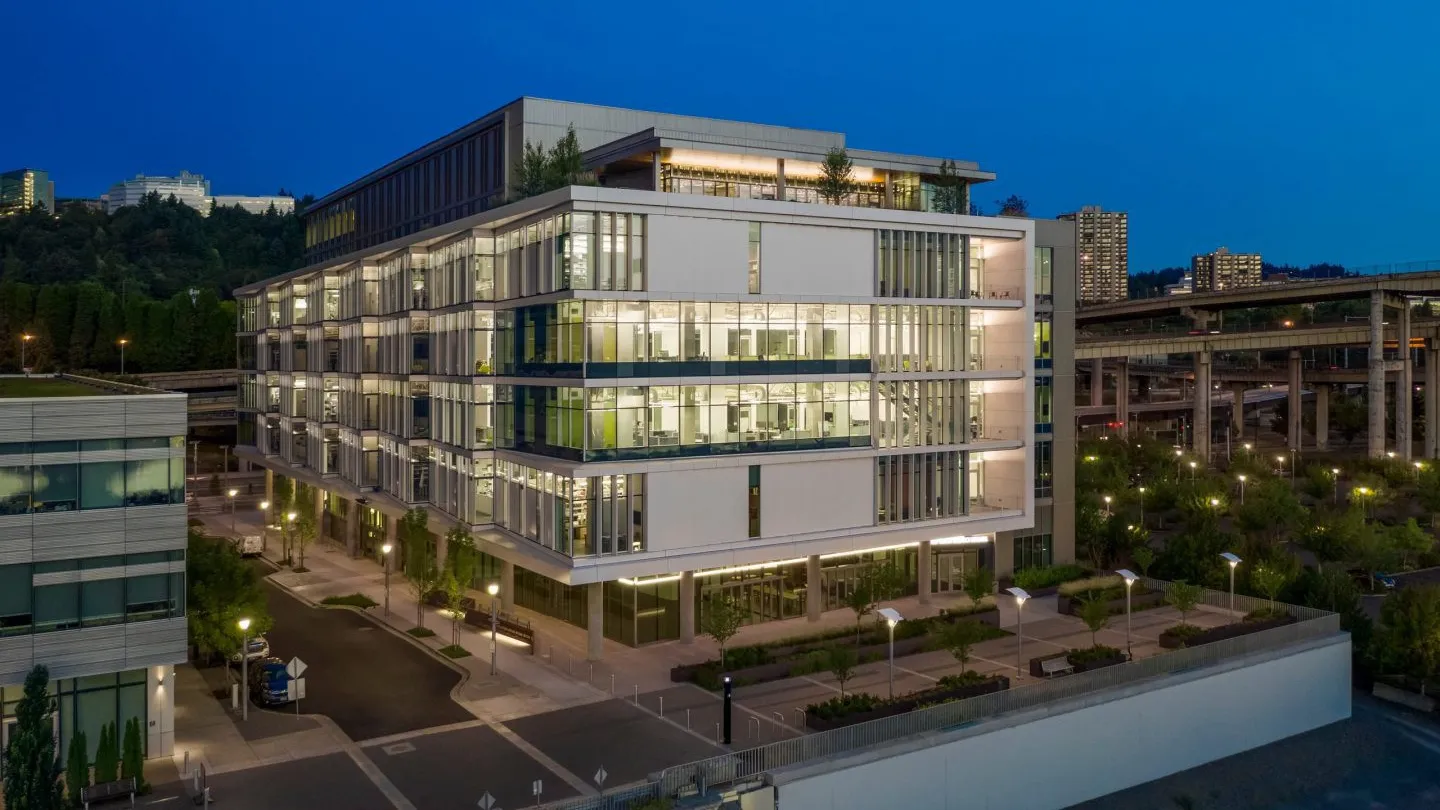
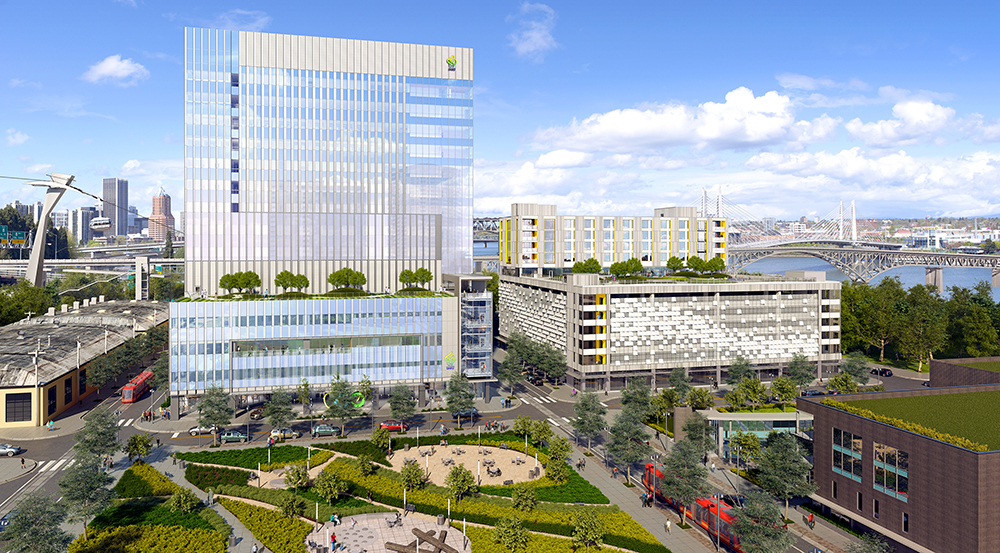
The Central Eastside Corridor blends innovation and industry—anchored by the OMSI District redevelopment and a robust industrial job base. It’s a hub for makers, creatives, and entrepreneurs; and an opportunity for investment to drive equitable growth and economic opportunity while embracing the riverfront.
Date Created
October 2024
District Status
Active
By the Numbers
Contacts
Prosper Portland contact:
Paul Gagliardi – gagliardip@prosperportland.us
Portland Housing Bureau contact:
Jessi Conner – Jessica.Conner@portlandoregon.gov
Email staff to attend or present at a meeting for your organization.
Join our email list
Please join our interested parties list to stay up to date on next steps.
Background
On October 30, 2024, Portland City Council voted to approve six new Tax Increment Finance (TIF) districts that will spur economic growth, create jobs, and invest in a range of affordable housing options in both Central City and East Portland over the next 30 years. Please visit the TIF Exploration page for more details about the exploration process that led to the creation of the new districts.
The Central Eastside Corridor TIF district incorporates 486 acres of the Central Eastside neighborhood including the OMSI and the Martin Luther King Jr / Grand Avenue and Stark Street corridors and began accruing resources on July 1, 2025. Prosper Portland and Portland Housing Bureau are collaborating with a community Working Group to develop a 5-year action plan for the district.
Action Planning is a budgeting and prioritization process to identify how to spend anticipated resources over the next five years, based on what types of investments are eligible as outlined in the TIF district plan. Resources are limited in the initial years of the TIF district but are expected to increase significantly over time.
In accordance with City of Portland set-aside policy, TIF resources are split 55% to Prosper Portland for economic and urban development projects and 45% to Portland Housing Bureau for development of new and preservation of existing affordable housing. For more information about the Portland Housing Bureau (PHB) TIF investments in the Westside TIF district, visit PHB’s website.
Meetings & Events
Meetings are open to the public and will include time for public comment at the start of each meeting. Agendas and meeting notes will be posted regularly on this website.
There are no upcoming events.
District Action Plan
TIF Plan & Reports
FAQs
No, TIF is not a new tax or fee. TIF uses the growth of property taxes within the district that people are already paying to invest in the community.
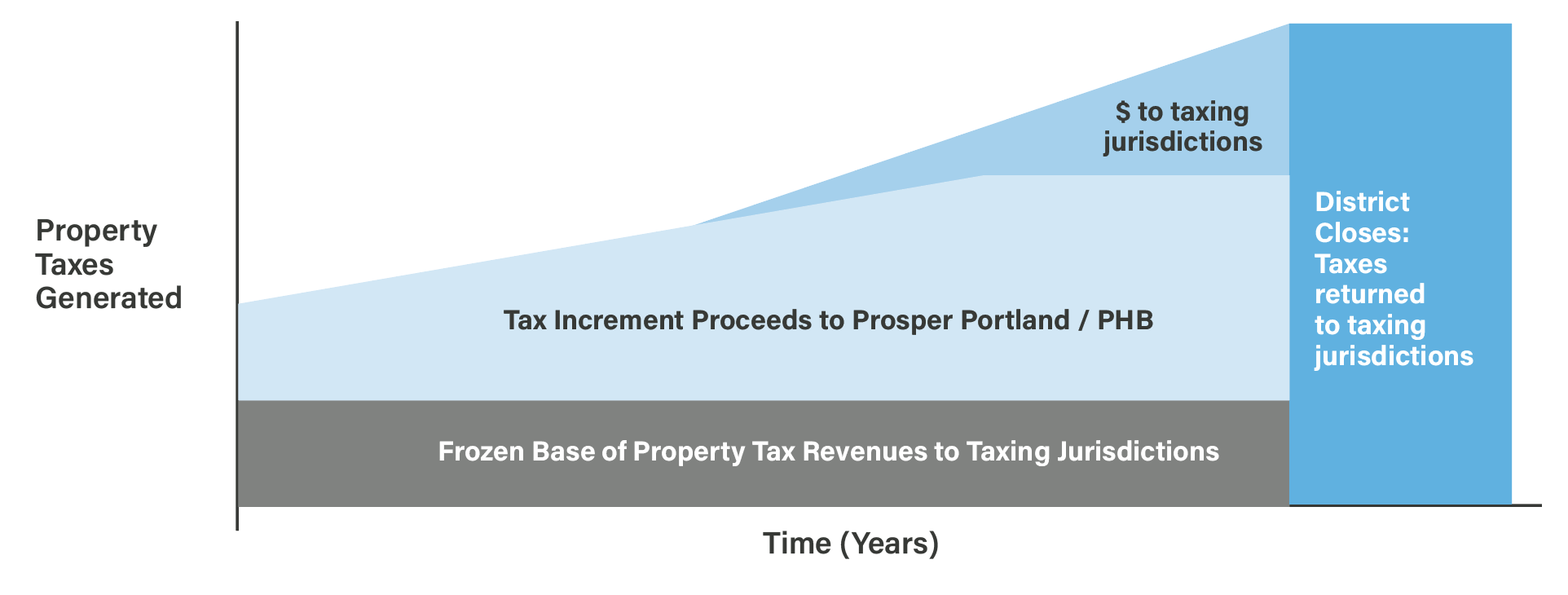
TIF is a way to use some of the property taxes you already pay to improve the community. When a TIF district is created, the City and County “freeze” the amount of property taxes they collect from the area within the district boundary. Over time, as the tax base increases from new development and rising property values, that increase may be used to fund improvements in housing, urban and economic development, within that boundary, for the next 20-30 years.
When a TIF district is set up, the property taxes from that area are split into two parts: the “frozen base” and the “increment.”
- Frozen Base: This money keeps going to local government agencies, like the City of Portland, Multnomah County, and school districts (such as Portland Public Schools, David Douglas, and Parkrose).
- Increment: As property values go up, the extra property tax money (called the “increment”) goes to Prosper Portland and the Portland Housing Bureau to invest in improvements to the district.
Once the TIF district ends, the property tax increment is given back to the local agencies.
The rules for how TIF funds can be used are set by the State of Oregon. TIF investments are limited to physical improvements that are permanent, including new construction and improvement to existing buildings. Grants and loans can be made available to construct or improve commercial properties, affordable housing and infrastructure (such as parks, streets, sidewalks, and transit), make home repairs, and provide downpayment assistance. TIF funds cannot be used for on-going services, such as workforce development programs, business technical assistance, paying rent, paying for services for residents or businesses, ongoing safety, security, or maintenance.
The City Council-approved set aside policy requires at least 45% of TIF resources across all TIF districts go to the Portland Housing Bureau to support affordable housing activities. The remaining 55% goes to Prosper Portland for economic and urban development.
Each TIF district has a set of priorities that are captured in the TIF district plan and a series of 5-year Action Plans to implement those priorities based on the needs of community at the time. TIF funds can only be used for projects that match the TIF District Plan and 5-year Action Plan and can only be spent within the district.
Each year, the Prosper Portland Board of Commissioners and the Portland City Council approve the budget for each TIF district. The way funds are distributed is consistent with the TIF district budget and follows the priorities set in each district’s plan. Funding awards may include a competitive public process or in the case of loans or grants, will rely on program guidelines adopted by the Prosper Portland Board and reported on to the public.
Prosper Portland and the Portland Housing Bureau must make sure that investments match the community’s priorities in the Five-Year Action Plan and follow the goals of the TIF District Plan.
The Prosper Portland Board is in charge of managing and authorizing TIF district expenditures and related development projects. Prosper Portland’s annual budget, including TIF districts, is reviewed by the agency’s Community Budget Committee, approved by City Council and the Tax Supervising and Conservation Commission (TSCC), and adopted by the Prosper Portland Board of Commissioners.
The Portland Housing Bureau manages the affordable housing TIF funds which are authorized by the City of Portland’s Executive branch.
Any new TIF district or major changes to existing district plans must be approved by the City Council.
Prosper Portland has played a critical role, through its projects and programs, in the city’s coveted reputation for smart urban development, including delivery of affordable housing and improving the quality of life for all Portlanders. Investments in nationally recognized, partnership-driven projects like the Williams & Russell Project, Pearl District, Eastbank Esplanade, the Portland Mercado, Pioneer Courthouse Square, and the Leach Botanical Garden put Portland on the urban planning map and draw talent and attention to the city.
However, in the City of Portland and Prosper Portland’s history there are projects and investments that also caused harm with impacts that reverberate today. Some of the agency’s historic development work deemed thriving communities of color “blighted,” and vibrant, diverse neighborhoods like South Auditorium and Albina were destroyed in the name of progress.
In the early 2000s, Prosper Portland leadership recognized the need for change and started to review its approach and policies. Some of the key actions indicative of Prosper Portland’s move toward more equitable and inclusive practices include:
2005- 2009
Prosper Portland enters into the South Waterfront Central District Apprenticeship Agreement (2005), adopts a Business & Workforce Equity Policy across major investments and projects (2007), and adopts a Five-Year Economic Development Strategy (2009). These policy changes were a clear acknowledgement that achieving prosperity for all residents requires explicit investments in retaining and growing businesses and workforce, funding innovation, and continuing to invest in key transit, infrastructure, housing, and urban development projects.
2010-2014
Prosper Portland adopted the Neighborhood Economic Development Strategy (2011) and the Equity Policy (2013) to incorporate an equity lens as an essential tool in every project. This strategy also incorporated a different approach to partnership, employing the community-led, community-driven model demonstrated by the formation of the Neighborhood Prosperity Initiative districts (2011).
2015-2019
Prosper Portland adopted another Five-Year Strategic Plan (2015) and an Engagement and Communications Strategy (2016) to provide new models for building an equitable economy and a framework for a more clear and consistent way to talk about its work.
In 2018, a coalition of community-based partners in the Cully neighborhood approached Prosper Portland to explore a community-centered TIF district creation process that centers historically underserved, marginalized, and underrepresented community voices in that process. Prosper Portland participated in a co-creation model that centered those most vulnerable to displacement with an explicit goal of stabilization.
2020-2024
The Cully TIF District was adopted unanimously by City Council (2022). Responding to the impacts of the COVID-19 pandemic, City Council directed Prosper Portland and the Portland Housing Bureau to build off the co-creation model developed by the Cully TIF district process and conduct TIF Exploration work in both the Central City and East Portland (2023). These efforts involved extensive engagement with community and local government partners, which informed the development of a proposal for six new TIF districts, three within Central City and three within East Portland. The six new districts were unanimously approved by City Council (2024).
The East Portland districts (82nd Avenue Area, East 205, and Sumner-Parkrose-Argay-Columbia Corridor) will help address the urgent need to stabilize existing businesses and residents while supporting inclusive economic growth for current and future generations. The Central City districts (Westside, Central Eastside Corridor, and Lloyd-Holladay) aim to bolster opportunities for targeted public investments to move catalytic projects forward and create new, mixed-income neighborhoods on both sides of the Willamette River.